The Art and Science of Maki-e
Wajima-nuri Sake Ware
Analytical Report by KYOTO’s 3D STUDIO Inc.

Featured
A Vessel That Shines When Sake Is Poured.
It Sounds Like a Lie, But It’s True.
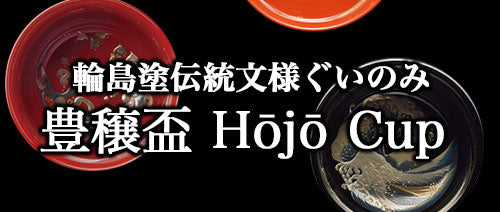
When sake is poured into a cup like the one shown here, light gathers onto the maki-e decoration, illuminating even the tiny gold particles that normally reflect very little light. This brilliance can only truly be understood when the vessel is held in the hand.
In traditional brush-painted maki-e, gold is not simply painted on. The artisan first draws lines with a brush soaked in lacquer. Before the lacquer hardens, fine gold powder is sprinkled onto it. After the lacquer cures, the same lines are traced again, sandwiching the gold powder between layers of lacquer. Yet at this stage, the gold still does not shine—because it remains as rounded particles.
Once the lacquer has fully hardened, the surface is polished with charcoal and other materials, creating flat reflective planes on each tiny grain of gold. Only then does the gold begin to reveal its true brilliance. This process is repeated layer by layer.
But maki-e does not reach completion when it leaves the workshop. In a sake cup like this, when sake is poured, light is guided across the surface and concentrated onto the gold, bringing even the faintest particles to life. In other words, the vessel is only truly completed when it is used by its owner.
Shogo Okagaki / CEO
Senshudo - Okagaki Lacquerware Co., Ltd.
-------------------
In this study, we explore the uniquely Japanese art of maki-e—where gold, silver, and colored powders are sprinkled onto lacquered surfaces—and reveal, through advanced 3D laser analysis, the scientific principles behind why these vessels shine, uncovering the extraordinary craftsmanship hidden within their microscopic structure.

Why Does It Shine?
Why is it that the maki-e decoration painted on Wajima-nuri sake vessels seems to emerge and begin to glow from the bottom the moment sake or water is poured inside?
The Hidden Secrets of Maki-e
Mechanism 1: Refraction of Light
When the surface of the maki-e becomes wet, the image appears three-dimensional due to the phenomenon of light refraction at the boundary between water and air.
As liquid covers the surface of the decoration, light bends as it passes through the water. This change in the path of light creates an optical illusion of depth, making the design appear to rise from within the vessel and take on a three-dimensional presence.
What Is Light Refraction?
How light travels:
Light normally travels in straight lines.
Why refraction occurs:
When light passes through the boundary between different materials—such as from air into water, or from water into air—its speed changes, causing the light to bend.
How optical illusion is created:
Our eyes assume that light always travels straight. As a result, objects under the water appear shifted from their true position, distorted, or bent. This visual misinterpretation is what we perceive as refraction.
Mechanism 2: Maki-e as an Assembly of Particles
Maki-e is one of the decorative techniques of lacquer art. The artisan first paints the design with a brush soaked in lacquer, and before the lacquer hardens, fine metal powders such as gold are sprinkled onto the surface. At this stage, only the basic silhouette of the design is formed.
The image is then refined through repeated processes: applying colored lacquer, layering additional coats, and polishing to bring out variations in tone and depth. Through these steps, the motif gradually takes its final form.
When liquid is poured into the vessel, refracted light reaches the inner layers of the maki-e. This light then illuminates the gold and other powders embedded within, causing them to emit a rich, lustrous glow.
Maki-e is not simply painted color. It is a composition of countless particles—metallic and colored powders—each reflecting light in its own way. Together, these individual grains create a brilliance that captivates the viewer, as if every particle were expressing its own unique presence.
Measurement and Data Processing Methods
Visualizing the Hidden Mechanisms of Maki-e in Wajima-nuri Sake Ware through 3D Technology


Measurement Method
To capture the surface relief of the maki-e decoration painted on the bottom of Wajima-nuri sake vessels, measurements were conducted using high-precision 3D laser scanning.
The following parameters were carefully controlled:
- Laser intensity and angle of incidence
- Point cloud density and sampling interval
- Multi-directional scanning and data alignment
By combining scans taken from different directions and overlaying the resulting point clouds, height and depth information of the three-dimensional structure of the maki-e was extracted, enabling detailed visualization of its microscopic relief and layered form.

3D ScanArm (Laser Scanner)
To visualize the maki-e decoration, 3D measurement was conducted using a non-contact, articulated-arm type 3D laser scanner (FARO Design ScanArm) with a resolution of 20 micrometers (20 μm).
Resolution refers to the ability of a measuring or imaging device to distinguish and detect fine details of a physical object, indicating how precisely the shape and surface structure of the target can be captured.
With this high-precision system, we attempted to visualize the microscopic relief and layered structure of the maki-e decoration in three dimensions.

Data Processing Method
While increasing the number of points in a point cloud improves the resolution of surface relief, it also increases computational load for coordinate calculation and surface image generation. In addition, extremely fine surface irregularities can introduce noise.
Therefore, it is necessary to balance processing efficiency with high-resolution visualization of the maki-e relief.
To achieve this, the following approaches are applied:
- Adjusting point cloud spacing according to surface materials such as lacquer base, metal powders, and colored powders, where necessary.
- Comparing different point densities and intervals to optimize resolution while suppressing noise and processing load.

Revealing the Relief of Maki-e from 3D Point Cloud Data
By analyzing color-equipped 3D point cloud data using only geometric coordinate information rendered in a single monochrome tone, the surface relief of the maki-e becomes strikingly clear.
When color information is removed, subtle variations in height and depth—created by the artisan’s brushwork and layering of lacquer and powders—emerge with greater clarity. Techniques that were hidden by visual color cues are revealed through the pure geometry of the surface, making the craftsmanship visible in a new, scientific dimension.

Detailed Analysis of 3D Point Cloud Data


Analysis Results
Because the bottom of the measured sake cup is curved, XYZ coordinate calculations and adjustments were first performed to establish a vertical reference axis between the maki-e relief and the lacquer base surface.
Subsequently, measurements were taken of the surface of the lacquerware and the layers of metal and colored powders.
As a result, the following height differences were confirmed:
- The height difference between the extracted maki-e (gold powder) area and the lacquer surface: 0.1407 mm
- The height difference between the colored powder layer and the lacquer surface: 0.0982 mm (≈ 98 μm)
A thickness of approximately 0.1 mm (98 μm) is comparable to that of a single sheet of copy paper.
This analysis reveals that the craftsmanship of Wajima-nuri artisans
who bring out the hidden “mechanisms of maki-e” operates within a world measured in mere 0.1 millimeters, or 98 micrometers.

Discussion
The Craftsmanship of Wajima-nuri Artisans that Maximizes the “Mechanism of Maki-e”
When the surface of maki-e becomes wet, the design appears three-dimensional. This effect is created by the phenomenon of light refraction at the boundary between water and air. As liquid is poured over the decoration, light bends within the water, producing an optical illusion of depth and making the image appear to rise from the surface.
When the surface of the maki-e is covered with liquid, a thin layer of water is formed. As the eye observes the decoration through this water layer, light is refracted once again at the interface between air and water. This refraction subtly alters the way colors—formed by gold and silver metal powders and colored pigments sprinkled onto the lacquered surface—are perceived. As a result, depth is created and the decoration takes on a three-dimensional appearance.
It is the micrometer-scale world and techniques of Wajima-nuri artisans that bring out this optical effect to its fullest.
To analyze and measure the delicate differences in relief and contours of the maki-e produced by these techniques, a non-contact articulated-arm type 3D laser scanner with a resolution of 20 μm was employed.
Furthermore, through 3D data processing and visualization, we examined Wajima-nuri, a traditional craft of Wajima City in Ishikawa Prefecture that has been designated an Important Intangible Cultural Property of Japan.
Wajima-nuri is one of Japan’s most representative forms of lacquerware and is defined by the following three conditions:
- The base material must be wooden.
- The surface must be reinforced with cloth.
- The undercoat must be made with “jinoko” (powdered diatomaceous earth).
Only lacquerware produced in Wajima under these conditions is called Wajima-nuri.
Conclusion
By applying contour mapping and volumetric visualization that limit and classify depth ranges of the maki-e relief, the discernible range of surface height differences was greatly expanded. This made it possible to clearly identify subtle variations in relief and form.
Through this approach, we were able to reaffirm the delicacy of the techniques inherited from the historical tradition of Wajima-nuri artisans, as well as their cultural rarity and value. The results demonstrate that 3D visualization and analysis provide an important key to understanding and appreciating the microscopic precision and aesthetic intelligence embedded in the craft of maki-e.
[Report]
KYOTO’s 3D STUDIO Inc.
https://k3s.jp/

KYOTO's 3D STUDIO Co., Ltd.
KYOTO's 3D STUDIO Co., Ltd. leverages advanced digital technologies to promote the preservation and utilization of cultural heritage, making significant contributions to local communities, the tourism industry, and the field of education.